





The Snail, the Slog, and the Taïga: A Recap of the Atlas Mountain Race
In February 2026, Robyn Hughes took part in the Atlas Mountain Race, an off-road ultra-distance race across Morocco’s Atlas Mountains. With her trusty Taïga, she faced rugged terrain, cold conditions, and unexpected detours, finding exactly what she had come for.
Words & photos : Robyn Hughes & one photo by Kari Bergstedt

I went into the Atlas Mountain Race (AMR) with a heavy dose of anxiety and a very light training block. A month before the start, a knee injury had left me unable to even pedal down the block. I had no idea what to expect, but I was ready to pivot with whatever the course, weather and my body threw at me. The goal was just to stay in front of the “snail”, which indicates the slowest time allowed.
As a woman in a sport where we usually make up less than 10% of the field, I was drawn to AMR not just for the terrain, but for the event’s conscious effort to increase our numbers. Being part of that movement felt as important as the riding itself.
The Pavement Slog
With an 8 day time limit and 1400km and 25,000m of elevation through rough, remote terrain, AMR is a test for any athlete.
However, an uncharacteristically cold and wet Moroccan winter meant that the first part of the race was rerouted to pavement to avoid snowed-in passes. I had trained for epic rocky terrain and instead I was starting a 350km time trial on the world's most forgettable surface (sorry roadies). My beloved Taïga, the confidence-inspiring queen of chunky terrain, felt less like my favourite adventure rig and more like a very reliable commuter bike.


The race began at 5pm and went straight up a mountain pass out of Beni Mellal, welcoming us with hours of pouring rain, sleet and below freezing temperatures.
Racers sheltered in any open cafe, and local kids dropped off buckets of hot coals for us to warm up with at 2am. Many of us called it the hardest night of our lives. By the time I hit Imilchil the next morning, sleep deprivation, a wonky stomach and a failing shifter cable brought me to a breaking point.
I sat outside a cafe with my bike upside-down –a broken sculpture against the backdrop of gorgeous, sunny mountains– and nearly called it. But ultra-racing is often about resetting your mind, body and bike. I fixed the cable, forced down half an omelette and decided to keep moving.
Then came the wind: a 20km, 7 hour hike-a-bike into gale-force winds that forced me to lean into my bike just to stand upright, wondering if we were going to be blown back to Beni Mellal. I was running on fumes, thousands of calories in the red, but I reached the top of the pass and realized I had just enough pace to make the Checkpoint 1 cutoff.
Finally, we hit the remote, dirt sections and everything changed. The terrain started to feel like home with short, steep hills and chunky roads that reminded me of Ontario.
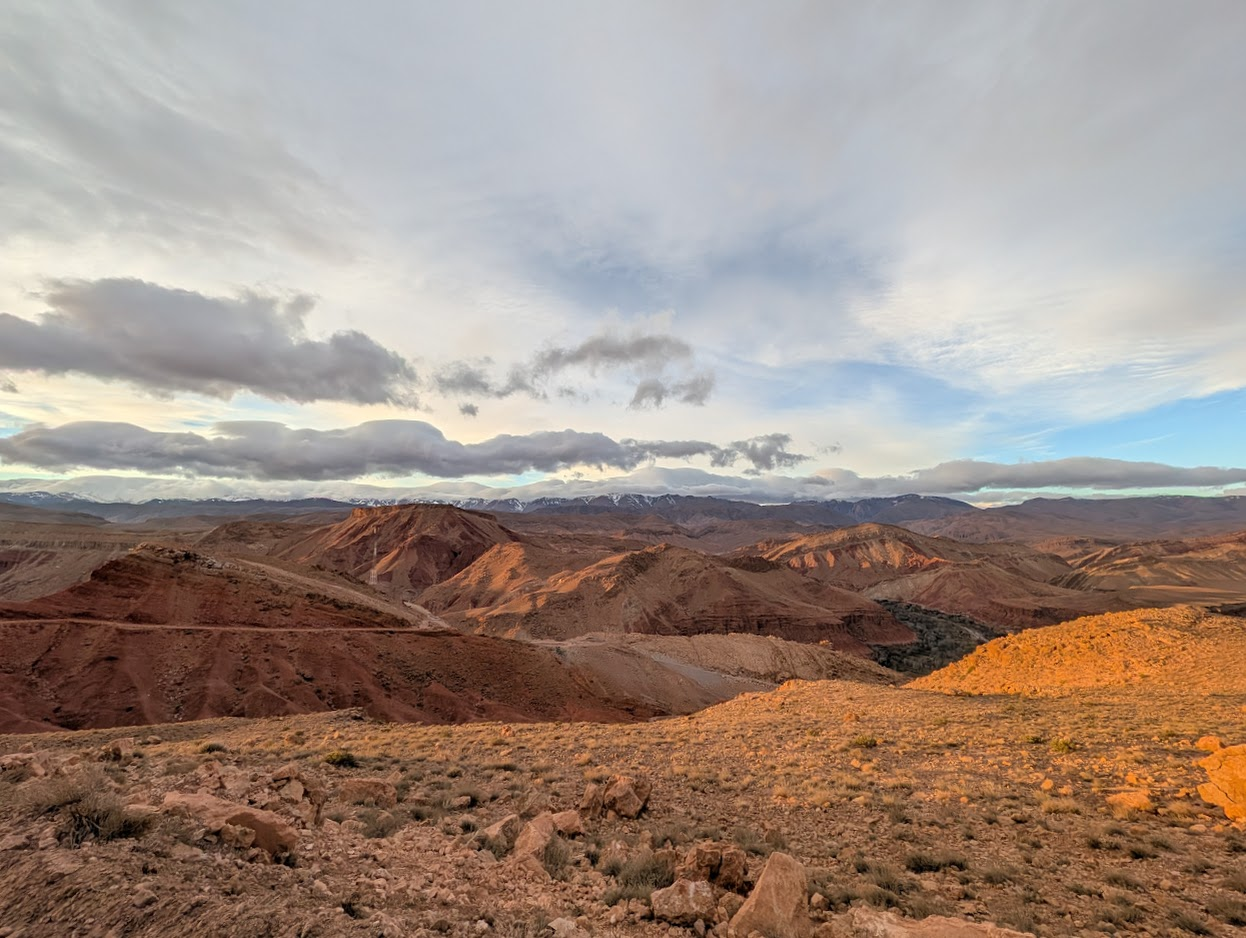
This is where the Taïga finally got to shine. While I had struggled on the pavement, the bike was a dream on the rocky pistes. I found myself doing something that never happens: dropping other riders on the descents and technical chunk. The Taïga's stability gave me a welcome boost of confidence, even with my physical state. I rode some of the best riding of my life: screamingly fast dirt descents into a setting sun, the rocks turning shades of amber and pink.


My Yogurt Gamble
By the time I reached Taznakht, I had spent days running on fumes, unable to finish a full plate of food. In a moment of desperation, or perhaps genius, I chugged about 2,000 calories of yogurt. I took a photo and sent it to a friend, who I suspect thought I had finally snapped.
I knew this move might backfire spectacularly, but it worked! My fermented friends fueled me to Checkpoint 2 with hours to spare. I finally felt like myself again, riding through the mountains under a canopy of stars, keeping the snail just behind me.


An Unemotional Decision
The end of my race didn't come with a finish line, but with a new injury on Old Colonial Road. Under a 30°C sun, my good, uninjured knee gave out. Having made it almost 900km, I felt fine ending my adventure in Issafn with no sense of failure. I had outrun the snail, survived freezing rain and ferocious winds, and proved that my injured self was still capable of incredible things.
What stays with me isn't the pain, but the people. The other racers who told me scratching was silly when I was at my lowest; the locals who opened their homes to stinky, broken cyclists; and the women alongside me proving that we belong in these wild spaces.
I didn't finish the route, but I found exactly what I was looking for.


